
Word, Image, Song: Birchbark
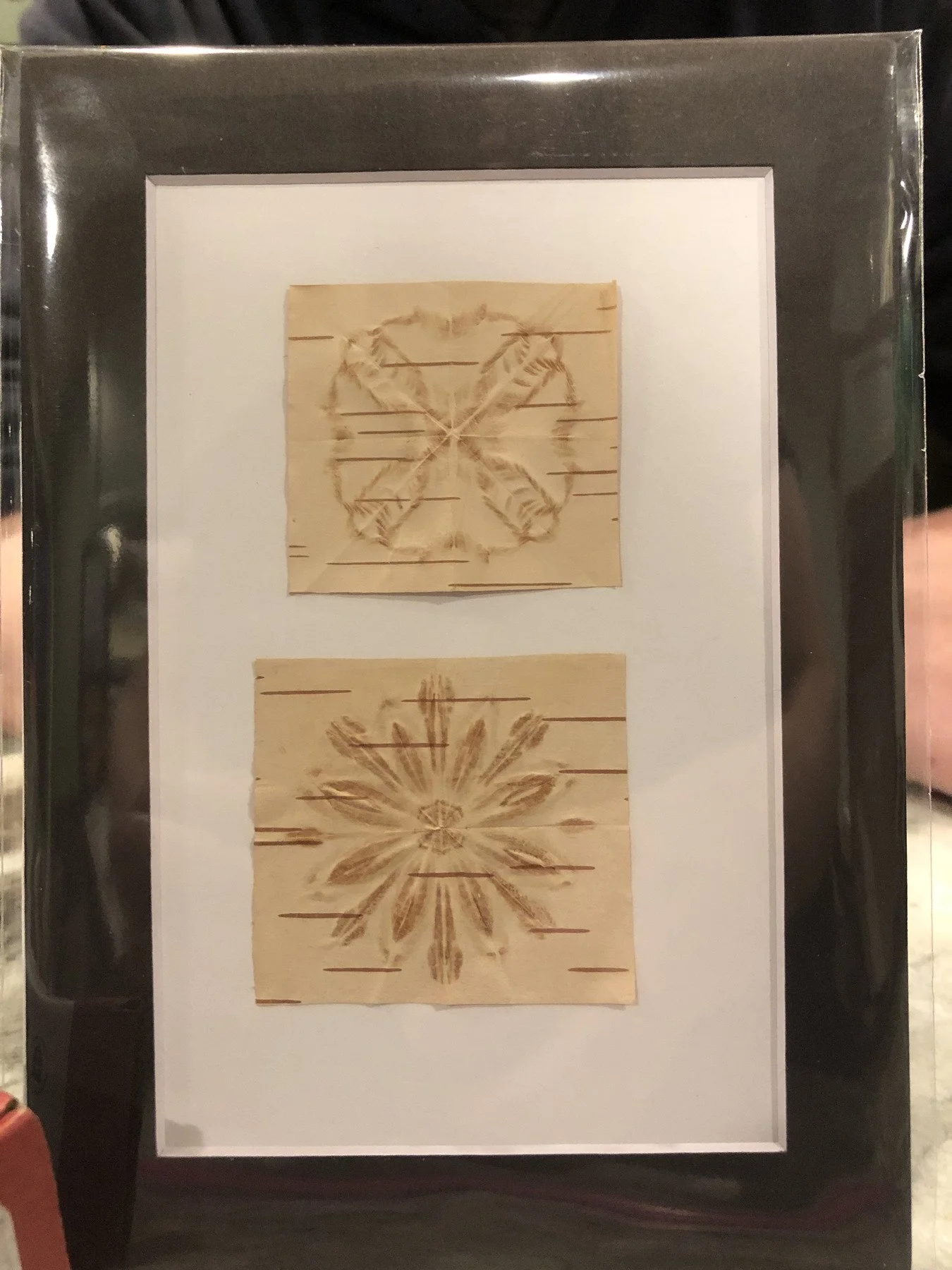
Have you ever made a paper snowflake? Birchbark biting is a similar concept.
I made these images with my teeth. Yes, teeth. The artform is called birchbark biting, and I was delighted to receive an invitation to learn about it during a workshop led by artist and culture keeper, Kelly Church, at the Minnesota Center for Book Arts. To say I was out of my element is putting it mildly. Initially, I thought we would use some kind of “biting tool”—probably made of metal—to work with the bark. What attracted me to the opportunity was the very word: birchbark.
To me, a stand of birch trees has a singular beauty. Almost pearlescent, the white bark of their trunks shimmer against the dark green conifers of the northern forest. Birch is also an extraordinarily useful and traditional material for many people, including indigenous nations in the USA. The Ojibwe, for example, built shelters and canoes from birch. The wood is lightweight, yet strong, as well as water resistant.
I think of the birch as the writer’s tree. From it, people have made paper for centuries. Personally, I have taken slips of birch bark from the forest floor to use as a canvas for pen and ink.
Have you ever made a paper snowflake? Birchbark biting is a similar concept. Begin with a sheet of paper and fold it in halves until you have a triangular shape. Then snip along the edges in a semi-symmetrical fashion. Ready to see what you’ve made? Unfold the paper and voilá—it’s a snowflake.
With birchbark biting, trade the scissors for teeth. Instead of eliminating paper, you’re making impressions on it. Instead of a standard sized piece of A4, you’re in charge of creating a symbol on the thinnest slip of birch. Honestly, it felt embarrassing at first. My teeth, in particular my gnawing canines, were exposed. My eyes scrunched in concentration as I tried to imagine the bites necessary to “draw” a turtle.
The teaching artist was kind as we showed her our initial efforts to bite the shape of an insect or animal. “What lovely flowers!” she said as all of us laughed. I returned home with an entirely new perspective on art making, especially how well an indigenous artist must know the shapes of traditional symbols. Can you interpret a form from your mind’s eye onto the page?
SONG
By Wood Smoke and Oranges Performed by Three Sheets to the Wind. Words and music by Ian Tamblyn © 1991 Sea Lynx Music SOCAN.
Oh, this song. It’s an entire mood, summarizing an atmosphere of campfire and twilight on Lake Superior’s wild shores.

FLOURISH
Practice drawing a flower or animal without looking at a reference picture. Don’t give in to the internet. Allow yourself the time to slow down and be specific, thinking about the lines and shapes that comprise what you’re imagining. Mindfulness exercises usually begin with the suggestion to imagine something in your mind’s eye. How often are you allowing yourself a chance to mentally practice drawing pictures?